

Count the voices you hear in a day that aren't coming from a person. GPS. Screen reader. Customer support line. Podcast ad read that sounds a little too smooth. A good chunk of those run on text-to-speech (TTS) – software that takes written text and turns it into spoken audio.
This article covers the mechanics: how modern TTS systems generate speech, what teams use them for, and where consent and ethics fit into a pipeline built on someone's voice.
Key Takeaways
-
Neural network text-to-speech generates audio that mirrors real speech patterns.
-
Scale points to text-to-speech. Performance fidelity points to speech-to-speech.
-
The real differentiator in TTS is ethics: consent, licensing, data security.
At its simplest, a text-to-speech engine reads text and speaks it out loud. In practice, there's a lot happening between those two steps. The system parses grammar, interprets punctuation, figures out context – then generates audio that reflects all of those decisions at once.
Older systems sounded like robots because they were, essentially, following a script of pronunciation rules. Modern ones run on Deep Neural Networks (DNN) – AI models trained on hours and hours of recorded human speech.
That training data is the reason a TTS voice in 2026 can pause before a comma the way a person would.
You've already heard this technology today, probably more than once:
-
screen readers for people with visual impairments or reading difficulties
-
navigation and smart assistant audio
-
e-learning and language apps
-
customer support bots
-
media and content platforms
What Is Neural TTS?
Standard TTS broke the job into pieces: text analysis, acoustic modeling, waveform generation – each handled separately, each introducing potential errors. Neural TTS handles it all in one pass.
Neural text-to-speech runs the whole conversion through a single model. What it learns from real recordings (pacing, stress, tonal shift) is what rule-based systems spent decades trying to approximate manually.
The cost is compute and data. Training neural voice models requires substantial speech data and processing power. But for teams that need broadcast-quality output at scale, it's worth it.



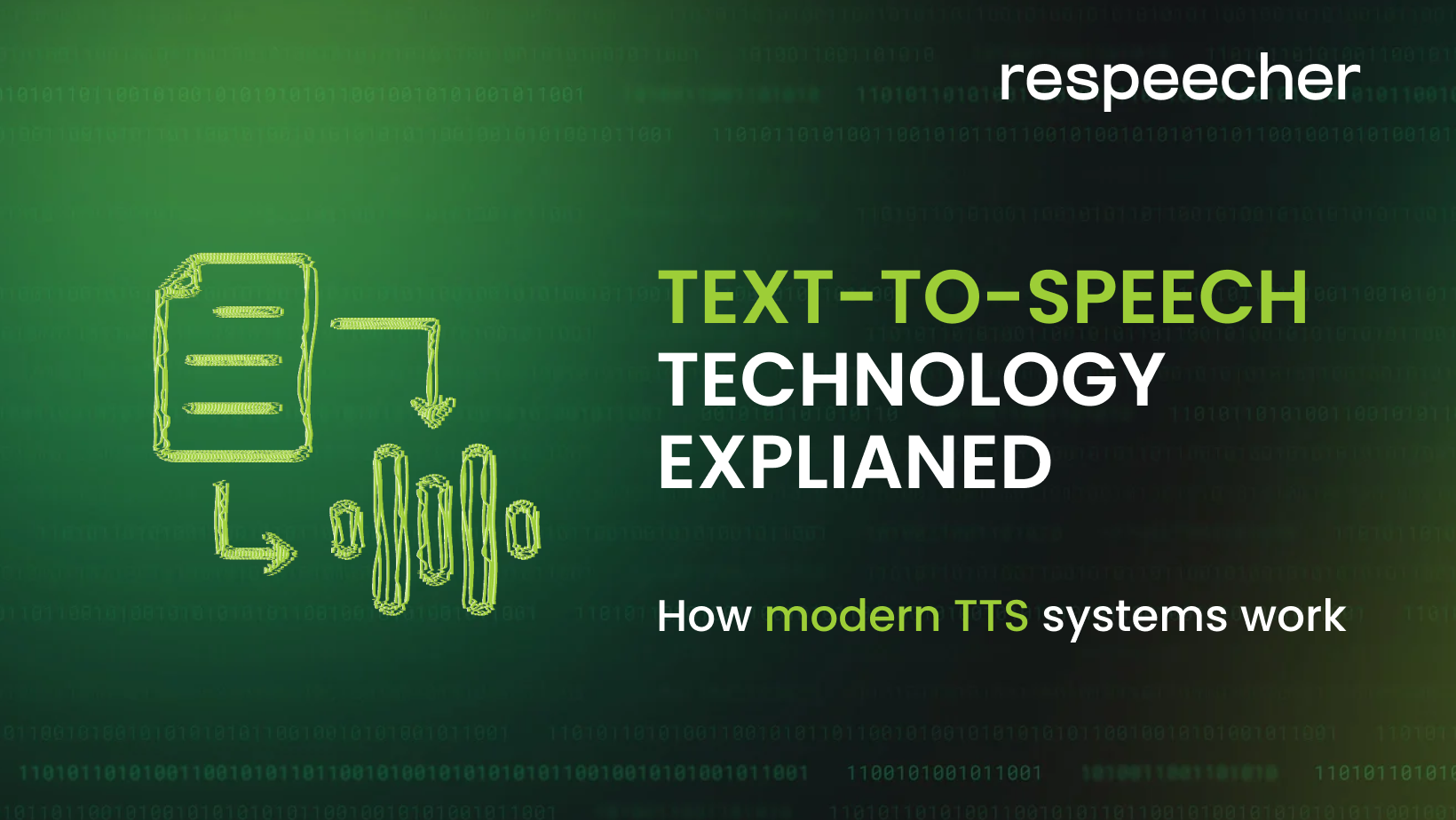
How a TTS System Converts Text to Audio
Four things happen between text input and spoken output:
-
text input – the system receives written language.
-
linguistic analysis – parses grammar, sentence structure, and phonetics.
-
prosody generation – assigns rhythm, pitch, and intonation to the text.
-
waveform generation – converts all of the above into audible audio.
Rule-based systems ran each step off manually written instructions – someone had to “tell” them how speech works. Neural TTS learns that from actual recordings instead.
Text-to-Speech vs. Speech-to-Speech: Which One Fits Your Project
Text-to-speech skips the recording session entirely. You type words, the system turns them into audio. No actor, no studio booking, no calendar juggling. That's why teams reach for it when the work needs to scale fast:
-
customer support systems
-
navigation audio
-
e-learning platforms
-
dynamic content that updates on a weekly (or daily) basis
The input is a script. The output is a voice. Straightforward.
Speech-to-speech works the other way around. A real person performs the line – with all the pacing, breath, and emotion that comes with it – and the system converts that performance into a different target voice. The human delivery stays intact. Only the voice identity changes.
That distinction matters when the performance carries the project:
-
preserving a legacy voice for a documentary or franchise
-
matching a character across sequels recorded years apart
-
keeping continuity intact when the original actor isn't available to re-record
So which one do you pick? Depends on the job. If you need volume and flexibility – hundreds of lines across languages, content that refreshes constantly – text-to-speech handles that well. If the emotional shape of the delivery has to survive the conversion, speech-to-speech is where you look.
How Do Teams Use Text-to-Speech Today
Text-to-speech now powers entire content pipelines – from global marketing campaigns to real-time customer service. Where it shows up most:
E-Learning & Accessibility
A student with dyslexia doesn't need better fonts. They need the content in a different format altogether. Text-to-speech handles that – turns the written material into audio they can replay, pause, slow down.
Works the same way for non-native speakers sitting through a course that's two levels above their reading comfort. They follow the narration while the text fills in gaps. Two channels instead of one.
Voice Assistants & Smart Devices
When Alexa reads you a recipe at 7 a.m. or Siri reminds you about a meeting at lunch, that's text-to-speech doing the talking. The trick is that the voice can't sound different depending on what it's saying or when it's saying it. People stop trusting a voice assistant the moment it sounds off.
News, Media, and Journalism
Newsrooms now convert written articles into audio versions automatically. Readers become listeners while commuting, cooking, or walking the dog. For publishers, it's a way to meet audiences where they already are – in their earbuds – without recording a single voiceover session.
Marketing & Brand Personalization
A brand's voice used to live in copy. Now it has an actual sound. Text-to-speech lets marketing teams produce voiced content for ads, customer service lines, and digital touchpoints at scale – all tuned to match the brand's tone.
Multilingual Content Delivery
Five years ago, launching a product in twelve markets meant coordinating schedules, reviewing takes, chasing consistency across studios in different time zones. Text-to-speech replaced most of that pipeline. You translate the script, run the generation, and the vocal identity holds across every version.
How to Integrate Text-to-Speech Through an API
Most text-to-speech platforms ship as cloud APIs. You send text, you get audio back. No speech engine running on your servers, no infrastructure to maintain. A developer can wire it into an app, a website, or an internal tool in a few hours – sometimes less, depending on the documentation.
Where APIs differ is in what happens after that first integration.
Respeecher's Real-Time text-to-speech API starts streaming audio within 200 milliseconds, regardless of how long the input text runs. That latency matters when the voice is responding to a live user – in a customer support flow, say, or an interactive learning module where a two-second delay kills the experience.
The voice library covers multiple languages, genders, age ranges, accents, and narration styles. So a team building a meditation app and a team building an in-game shopkeeper can pull from the same API and end up with completely different-sounding results.
One thing worth flagging on the security side: Respeecher doesn't feed customer data back into model training. Your content stays yours. That's a question more teams are starting to ask during vendor review, and it's better answered before procurement gets involved.

Why Ethics and Voice Consent Can't Be an Afterthought
The better synthetic voices get, the easier they are to misuse. Unlicensed clones already circulate online – voices copied without the owner knowing, used in content they never approved. It's already happening, and it's already causing legal and reputational problems for the companies involved.
This is why consent has to come before the first audio file is ever generated. Not as a checkbox, but as the starting point of the entire workflow.
Respeecher works exclusively with licensed, consent-verified voice data.
Every voice in the system has a clear chain of permission behind it. On top of that, built-in moderation tools flag and prevent unauthorized use – so the safeguards aren't just policies on a page, they're baked into the platform itself.
Final Thoughts
Text-to-speech went from a novelty feature to a production essential faster than most teams expected. It's in classrooms, newsrooms, contact centers, and app interfaces – and it's scaling from there.
But scaling a voice without knowing where it came from is a liability. The teams getting this right are the ones who ask the hard questions before the first API call: whose voice is this, did they agree, and what are the limits?
Respeecher exists for exactly that kind of team. Consent-verified voices, studio-grade output, and a pipeline built so that nobody has to wonder whether the foundation underneath is solid. It is.